
The concept of barrier-free slope
In fact, as long as you go up and down the slope, there is a slope problem, but today we will only talk about the concept of barrier-free slope. For pushing a wheelchair up and down a barrier-free slope,
Other automobiles, motorcycles, pushing goods or other strange applications will be discussed in the future when we have the opportunity.
When the height remains unchanged, the longer the barrier-free ramp, the gentler the slope, and the shorter the barrier-free ramp, the steeper the slope. This is basic common sense,
A difference of 1 degree in barrier-free slope will be noticeable to the driver, but a slope of 1 degree cannot be distinguished by the naked eye.
Many people often say that the visual measurement is 45 degrees, but I dare say that 95% of the calculated results are less than 45 degrees.
45 degrees is a very steep slope. You have to keep your center of gravity forward even when walking. It is not surprising if you accidentally slip and fall, let alone push a wheelchair up and down.
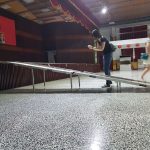
There is a demonstration of 37.3 barrier-free slope in the video. It is definitely not just a random slope.
I often encounter some very exaggerated requirements. If the height is 40 cm, I need to buy a 50 cm slope board!
This simply means that the board is erected at the same height. How can the concept of almost two parallel lines become a slope?! The barrier-free slope is too steep not only for wheelchairs to push it up, but also more dangerous when coming down. It is better to find two people to lift it up directly to save money and effort. and safe
barrier-free slope calculation
Generally speaking, the barrier-free industry professionals refer to the multiple ramp lengths as the height multiplied by 4 or 5 or 6 equals the length of the accessible ramp.
Multiplying by different multiples represents different barrier-free slopes. The larger the multiplied number, the longer the slope and the gentler the slope. When the two parties communicate, the slope is too vague and incomprehensible. It is faster to directly get the required slope length by talking about the multiple. way of communication
Assuming the height is 10 cm, the barrier-free slope multiplied by different multiples is as follows:
- 40 CM Slope length , Slope is 14.48
- 50 CM Slope length , Slope is 11.54
- 60 CM Slope length , Slope is 9.59
- 70 CM Slope length , Slope is 8.21
- 80 CM Slope length , Slope is 7.18
- 90 CM Slope length , Slope is 6.38
- 100 CM Slope length , Slope is 5.74
- 110 CM Slope length , Slope is 5.22
- 120 CM Slope length , Slope is 4.78
It is common to see long and gentle barrier-free ramps in front of 7-11, which are 12 times the length of the ramp. It is enough for people with disabilities to push wheelchairs up and down by themselves. It is difficult to improve the barrier-free environment at home to have enough space to make it so long.
What is the appropriate slope for barrier-free access?
When the barrier-free slope remains unchanged, the physical strength of the person pushing the wheelchair and the weight of the person sitting in the wheelchair are also two important variables. If the person pushing the wheelchair is thin and weak or the person sitting in the wheelchair is heavier, a gentler barrier-free slope will be needed to achieve a smooth and smooth ride. Safely push the wheelchair up and down the barrier-free ramp, the slope, physical strength and weight are closely related. Do not regard the women around you as Wonder Woman. Physical strength is difficult to see from the body shape, and age will also affect physical strength…especially for women, only Can analyze from many experiences, find an average value, and then increase or decrease the slope according to different physical strength and weight conditions.
My personal analysis standard: Regardless of the weight of the person in the wheelchair. Irrespective of the occupation, body shape, age of the person pushing the wheelchair, foreign workers or Taiwanese women (generally weaker than foreign workers), a young and healthy woman can run 4.5 times the length of the ramp. Barrier-free slope 12.84 When pushing a patient weighing less than 65 kilograms up and down the barrier-free slope, the weight of the wheelchair does not need to be taken into account. Under this premise, if the patient is thin or elderly or the wheelchair user is overweight, the weight will be increased depending on the situation. The length of the barrier-free ramp can be used to smooth the slope. Some foreign workers are physically stronger than this average and can lift the patient. The length of the ramp can be reduced to 4 times. Some foreign workers fall exactly within this average, and only a very small proportion of foreign workers are biased. emaciated.
The average value I picked is very accurate because I have accumulated a lot of practical experience as a Taiwan Ramp Expert. The following video is about deliberately setting up 4 times the length of a barrier-free ramp for Taiwanese women of different ages to test it in a wheelchair during the sales education training. Weighing 60 KG, everyone only understood how important the barrier-free slope is after actually pushing it once. The difference between 4 times and 4.5 times is only 25 CM in length of the slope, and the difference in slope is only 1.64. The difference in slope is not visible to the naked eye, but it is crucial to the ability of the wheelchair. Can one go up and down the barrier-free ramp smoothly and safely?
An explanation of the concept of barrier-free slope
The difficulty in improving the barrier-free environment at home lies in the lack of space in most homes and the limited length of straight-line barrier-free ramps.
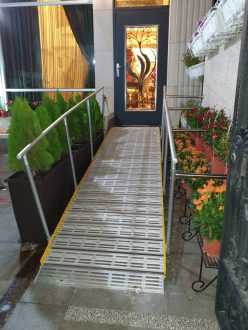
And then will need to use Aluminum alloy platform to build a landing for turning to accomplish barrier-free slope. More details in video about the concept of barrier-free slope
CYHB – Taiwan Ramp Expert
TEL : +886-800-222-666
YouTube Channel : https://www.youtube.com/channel/UC5lO2znBXE8FzdhOUUaRL_Q