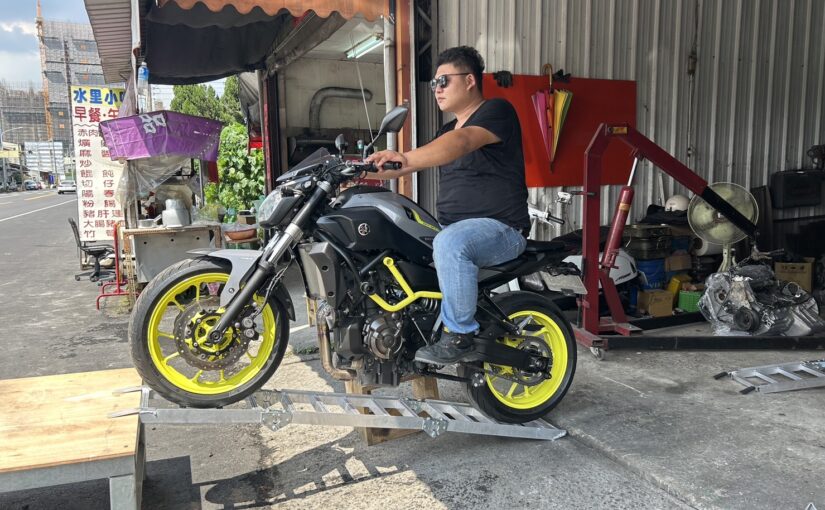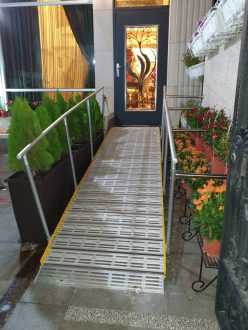
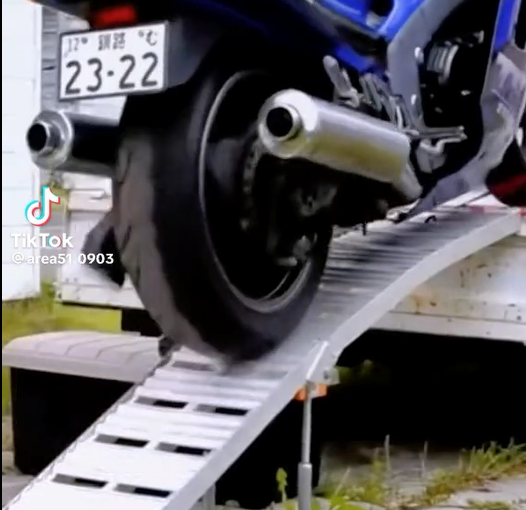
Incorrect usage examples for using support legs
When we make the support legs, we always use the height informed by the customer, and then evaluate it based on the terrain in the photo, and then reduce it by at least 1 CM. It will not be too high or just right. It is suitable for any scene that requires the use of ramps.
The reasons are as follows:
- Measurement error. If the support leg is too short, it can be raised. If it is too high, it cannot be lowered.
- The ground is not absolutely level and must be reserved for customers to make fine adjustments.
The support legs were adjusted too high, resulting in insufficient force on the upper tongue plate. After the front wheel broke away from the plate, the rear wheel rolled and fell over completely. On the other hand, the upper tongue plate is pressed tightly by the weight because there is no support legs, unless step on it.
In terms of accessibility, we often see customers adjusting the support legs of half-fold ramps too high, resulting in a bulge in the middle of ramp. The right solution is to balance the force on the upper and lower ends and the supporting feet, or it would be better to adjust it a little lower. It doesn’t matter if the bottom of the foot is 1 CM away from the ground. As long as a person and the weight of the wheelchair are pressed up, the slope plate will sink and the feet will touch the ground. This method can ensure that there is sufficient pressure on both ends and allow the supporting feet to play their due role.
Continue reading Primary school of Ramps CHAP. 50 – Cannot just relay on support legs